Snail mail is dead. Or is it?
When Instagram inboxes are overflowing and emails go unread, sometimes the most interesting marketing opportunity is the one arriving through the letterbox.
By Alexis Drake
Over the past few months, I've been attending a series of beauty industry networking events in Milton Keynes, hosted by specialist accountants The Balance & The Bliss at the NatWest Accelerator Hub. They've provided a fascinating opportunity to meet salon and clinic owners, understand the realities of running their businesses and, perhaps most usefully, listen to what they say when they're talking to one another.
One theme has come up repeatedly: communication is becoming increasingly difficult to manage.
I've heard business owners describe Instagram inboxes overflowing with messages, emails they rarely find time to read and LinkedIn accounts they simply don't use. Between patient enquiries, appointment changes, suppliers, promotional offers and the everyday demands of running a clinic or salon, their digital communications can become a rather unruly collection of competing priorities.
These weren't formal research interviews, and I wouldn't pretend that the conversations represent every business in the sector. Nevertheless, they gave me valuable firsthand insight into the habits and frustrations of the particular audience I was hoping to reach.
At the time, I was developing an entrepreneurship training proposition for medical aesthetics practitioners and exploring ways to introduce Octavia's Revenge to established clinics. Like many new business owners, I was considering the usual approaches: email introductions, LinkedIn messages, Instagram outreach and networking.
But something was bothering me. If the people I wanted to speak to were already struggling to manage their digital messages, why would adding another one to the pile be a particularly effective strategy?
Choosing a channel your audience actually notices
Marketing advice has a habit of becoming rather prescriptive. We're told that businesses need to be active on Instagram, build their LinkedIn presence, develop email sequences and produce a steady stream of content. There's plenty of value in those channels, but their effectiveness depends on whether the intended audience actually uses them in the way we expect.
An established clinic owner spending most of the day treating patients may have very different communication habits from somebody working at a desk. Their Instagram account might be an important source of patient enquiries, but that doesn't necessarily make it a good place for an unsolicited business proposition. Similarly, the existence of a business email address tells us very little about how frequently it's checked or whether messages from unfamiliar senders receive any attention.
The distinction is important because reaching somebody and being noticed by them are not the same thing.
I began wondering whether a physical approach might offer an advantage. Not because traditional direct mail is inherently better than digital marketing, but because it might be less crowded in this particular context.
If the digital inbox was becoming an increasingly noisy environment, perhaps the letterbox deserved another look.
Enter the purple feather
The resulting campaign was what marketers sometimes call lumpy mail: direct mail containing a physical object that makes the envelope feel different from an ordinary letter.
I wanted something that would be recognisably Octavia's Revenge, sufficiently unusual to provoke curiosity and relevant to the people receiving it. It also needed to communicate something about my approach to business strategy rather than simply functioning as a novelty.
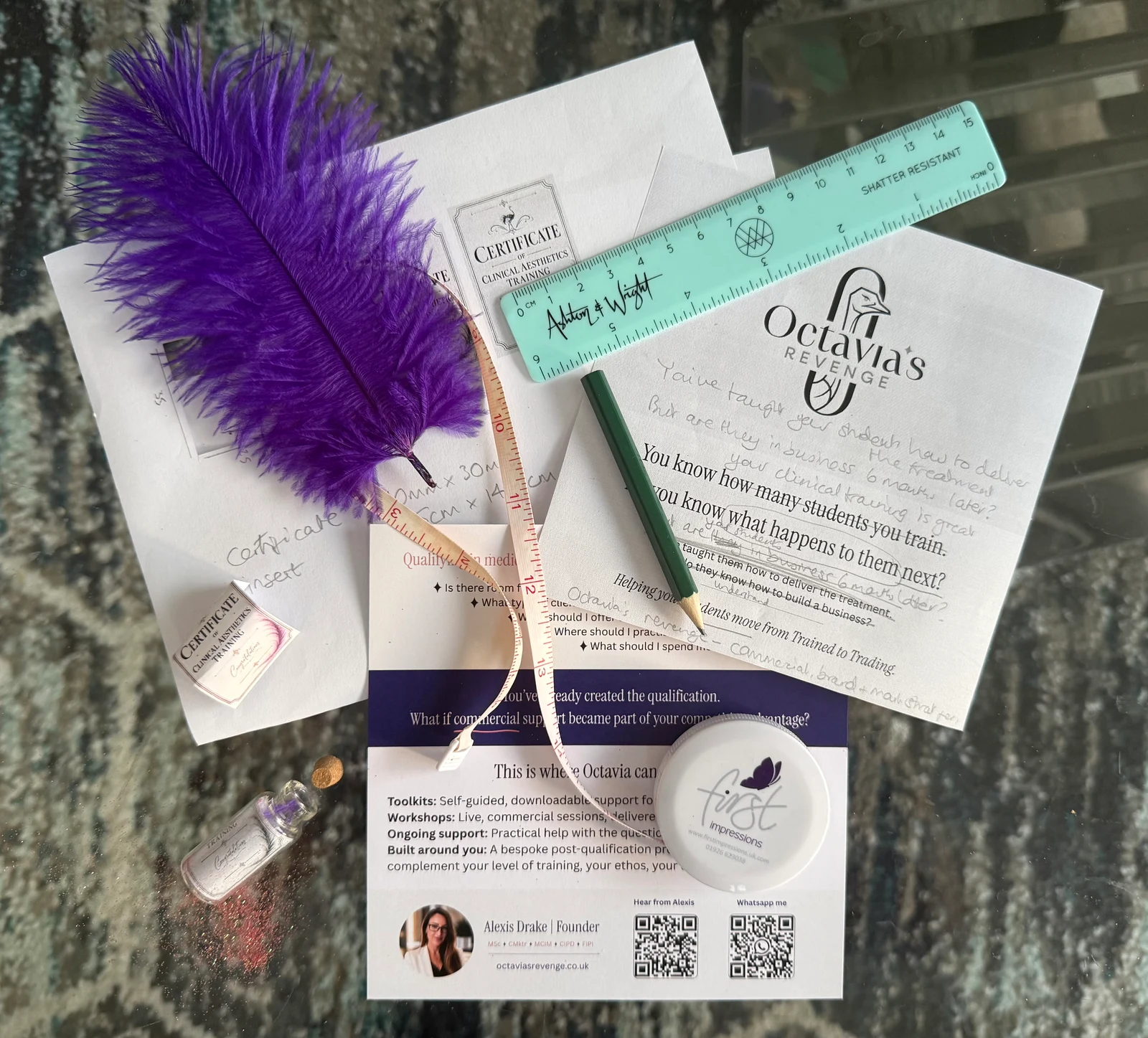
The finished packages contained a collection of small objects, including a purple feather, a miniature certificate, a measuring tape and a ruler, alongside printed material introducing Octavia's Revenge and the support I was developing for practitioners moving from clinical training into business.
The certificate represented the qualification. The measuring tools suggested the importance of assessing an opportunity rather than simply assuming it existed. The feather, naturally, belonged to Octavia, my increasingly conspicuous ostrich.
There was also a more serious message behind the theatrics. Practitioners may leave training with new clinical knowledge, but they still need to understand their market, establish a proposition, work out their economics and decide how to attract patients. My intention was to introduce that commercial thinking in a way that might stand out from the usual stream of digital sales messages.
I sent an initial batch of 20 packages to selected businesses, having researched the types of clinics I thought might be interested in the proposition.
It was a modest experiment rather than a large-scale campaign, but one designed around what I'd learned about the audience rather than simply following the most fashionable marketing channel.
Being memorable isn't the same as being effective
Of course, a purple feather doesn't guarantee a meeting, let alone a new client. The campaign still needs to be evaluated against its objectives, including whether recipients respond, whether the conversations are commercially relevant and whether the time and money involved justify the approach.
There are also practical disadvantages to physical mail. It requires more preparation, printing, assembly and postage than sending a message online. Accurate recipient details matter, and there's no guarantee that an envelope will reach the intended decision-maker.
But those limitations don't invalidate the experiment. They simply become part of the assessment.
What interests me is that the campaign was developed in response to a specific audience insight. I wasn't choosing direct mail because it was nostalgic or because somebody had declared it the next big marketing trend. I was testing whether a less conventional approach might be more noticeable to a group of business owners who had repeatedly described feeling overwhelmed by digital communication.
Whether it ultimately delivers a worthwhile commercial return is a separate question, and one that needs evidence rather than enthusiasm to answer.
What if you're the practitioner trying to get noticed?
There's a wider lesson here for people entering medical aesthetics, particularly those hoping to establish themselves within an existing clinic.
Imagine you've recently completed training and want to approach local businesses about renting a treatment room, working as an associate or exploring a potential employment opportunity. You identify several clinics that look suitable and begin sending Instagram messages asking whether they have any space available.
There's nothing necessarily wrong with that approach. But if those businesses are already receiving dozens of messages every day, you may find yourself competing for attention in an inbox that the owner barely has time to manage.
Before sending another message, it may be worth asking how the business actually operates and what would make your approach relevant to its owner.
Perhaps a carefully researched letter would stand out. Perhaps an introduction through a mutual contact would be more effective. A short telephone conversation, a professional event or a thoughtfully prepared proposal might provide a better starting point.
The answer will depend on the business and the nature of the opportunity.
And being different isn't enough on its own. A memorable approach still needs to communicate why the recipient should be interested.
For a practitioner seeking a place within an established clinic, that means thinking beyond what they personally want. The clinic owner will also be considering whether the proposed services fit their existing clientele, whether there's sufficient demand, how the arrangement would work operationally and what commercial or clinical responsibilities it would introduce.
A generic message saying you've recently qualified and are looking for somewhere to practise may be easy to overlook. A considered approach demonstrating that you understand the clinic, its patients and the potential value of a collaboration gives the recipient a much better reason to engage.
The medium might get you noticed, but the proposition is what makes the conversation worthwhile.
The diagnosis
The most useful marketing insight doesn't always come from a dashboard, an analytics platform or a report about the latest social media trends. Sometimes it comes from sitting in a room with the people you want to reach and listening carefully to how they describe their working lives.
For me, those conversations in Milton Keynes challenged an assumption about how I should approach prospective clients. They prompted an experiment with a channel that many businesses might overlook, but which appeared worth testing for this particular audience.
The same principle applies to aspiring aesthetics practitioners hoping to attract patients, find clinic partners or establish professional relationships.
Before deciding how to reach somebody, take the time to understand how they prefer to be reached, what competes for their attention and why your proposition might matter to them.
Sometimes the best way to stand out in a digital world is to do something distinctly analogue.
And sometimes, apparently, it involves posting an ostrich feather.
Strategy before spend. Always.
About the author
Founder, Octavia's Revenge
Commercial, brand and marketing strategy for medical aesthetics businesses.
Keep reading
 Observations
Before you leave the NHS, do the maths.
Two conversations. Two very different ambitions. And one financial consideration that deserves considerably more attention.
Alexis Drake
 Observations
Frequent flyers: when another training course becomes the business plan
There's a pattern I'm beginning to recognise in medical aesthetics. Practitioners invest in clinical training, struggle to establish a paying patient base, and then decide that the next step towards growing their business is more training.
Alexis Drake
 Observations
Buying things for your aesthetics business isn't the same as building one
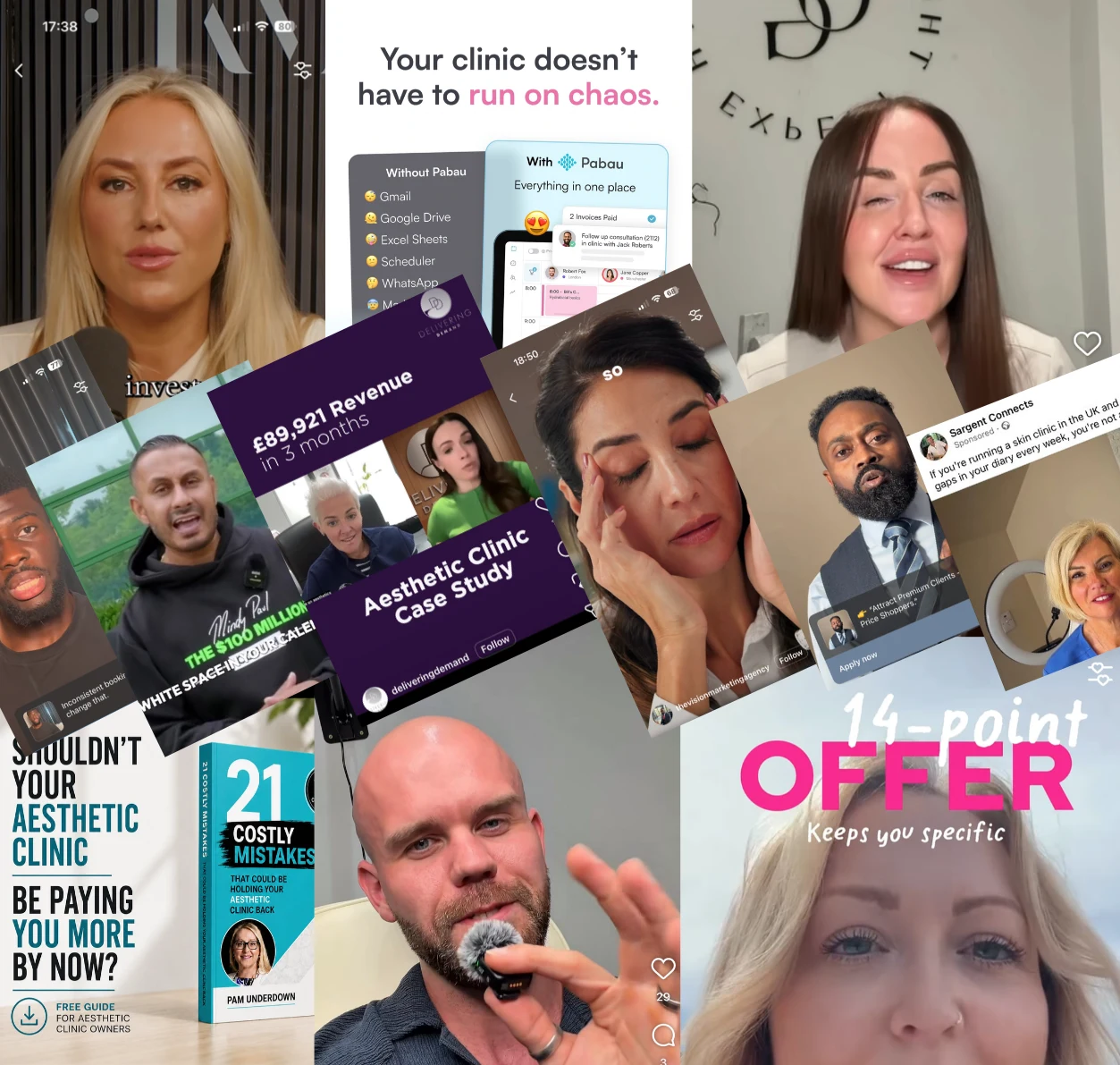
Eight minutes on Instagram, dozens of promises and a question every aspiring aesthetics practitioner should ask before reaching for their wallet.
Alexis Drake