Buying things for your aesthetics business isn't the same as building one
Eight minutes on Instagram, dozens of promises and a question every aspiring aesthetics practitioner should ask before reaching for their wallet.
By Alexis Drake
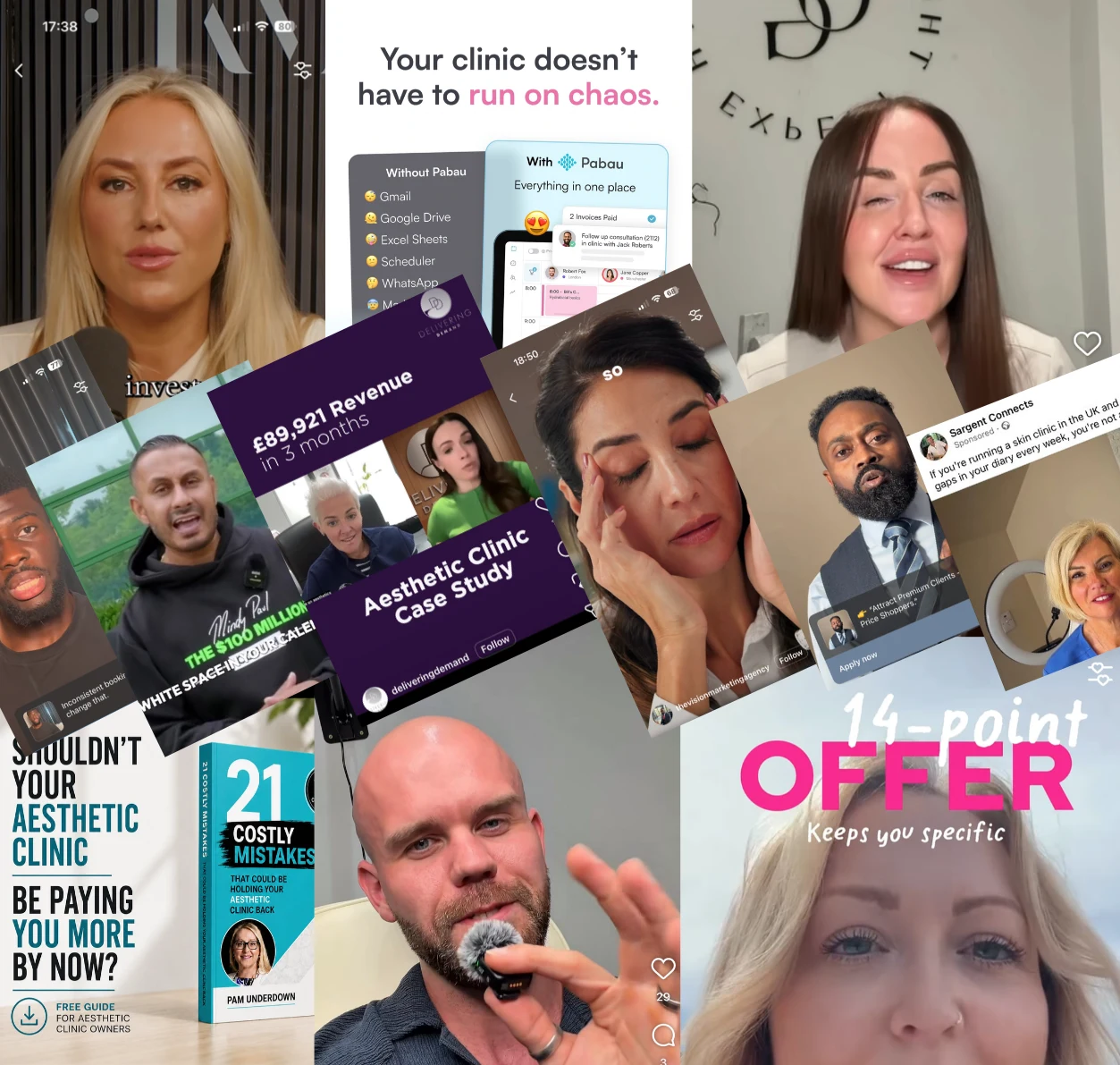
Recently, I spent about eight minutes scrolling through Instagram, taking particular notice of the marketing messages being served to people working in medical aesthetics. The image accompanying this article is a collage of what I encountered during that brief period.
There were advertisements for clinic management software, marketing agencies, business coaches and mindset programmes. Books promised to reveal the mistakes holding clinic owners back, while others offered the secrets to filling appointment diaries or achieving impressive monthly revenues. And, of course, there was the tantalising prospect of those elusive five-figure months.
I wasn't deliberately searching for any of these services. I was simply scrolling through a feed that had clearly worked out my interest in the aesthetics industry. Within eight minutes, I'd been presented with enough products, programmes and promises to make my head spin, and I wasn't even the person being asked to buy anything.
It made me wonder how a newly qualified practitioner might navigate this extraordinary volume of commercial advice, particularly someone who is ambitious, relatively inexperienced in business and fortunate enough to have some money available to invest.
An industry ready to help you spend money
There are, of course, excellent businesses providing genuinely valuable services to aesthetics practitioners. A suitable booking system can improve administration and patient experience, a good marketing agency can help a business reach the right people, and an experienced adviser can provide commercial expertise that a clinician may not possess. Investment in appropriate clinical training, professional development and patient safety is also essential.
My concern isn't that these services exist, or even that they're being actively marketed. It's that practitioners can encounter them long before they've established which are appropriate for their particular business, whether they're commercially justified or, indeed, whether they're needed at all.
When you're entering an unfamiliar industry, surrounded by confident voices explaining what successful clinic owners do, it's remarkably easy to confuse acquiring the components of a business with building a viable one. A beautiful website, sophisticated booking platform, carefully designed logo, collection of treatment devices and outsourced marketing team can all create a reassuring impression of progress.
Each purchase makes the venture feel a little more established, and some may prove to be excellent investments. But none of them, individually or collectively, establishes that sufficient patient demand exists or that the business can operate sustainably.
When looking established becomes the priority
I've encountered this dynamic in my own consulting work. While working with a clinician preparing to establish a private aesthetics practice, I became interested in how much of the early activity had focused on the visible elements of having a business: the things that could be purchased, commissioned, designed or announced.
There had been enthusiasm, research and expenditure, all of which were perfectly understandable. However, when we began examining the commercial foundations, we found that some much more fundamental questions still needed answering.
Who, precisely, would the practice serve? Where was there a credible market opportunity, and which treatments would make sense to offer initially? What would the economics look like alongside existing NHS commitments, how much capacity was realistically available, and what would need to happen for the business to become commercially sustainable?
These weren't minor details to resolve once everything else was in place. They were the decisions that should inform almost everything else, from the location and treatment portfolio to the website, marketing activity and investment priorities.
As the work progressed, our attention shifted away from adding more things to the business and towards establishing what the business actually needed to be. That involved narrowing the initial proposition, evaluating different routes to market and considering how to establish a viable practice without committing prematurely to unnecessary overheads.
It also meant accepting that not every attractive opportunity deserved investment, and that even a sensible purchase might be better made later.
Why spending can feel like progress
I suspect there's something very human behind this behaviour. Starting a business involves a considerable amount of uncertainty, and much of the most valuable early work produces nothing particularly tangible.
You can spend weeks researching a market without knowing whether enough people will buy what you intend to offer. You can examine competitors, pricing and patient demand only to discover that the idea you were initially excited about needs reshaping. You might even conclude that the opportunity isn't sufficiently attractive to pursue.
None of this provides the immediate satisfaction of buying something.
Commission a logo, and you have a logo. Build a website, and you have a website. Subscribe to a booking platform, and suddenly you have a system that looks ready to receive patients. These are visible achievements that can make the business feel more real, even when its underlying commercial proposition remains uncertain.
Sometimes those purchases represent genuine progress. At other times, they simply make the business more expensive before making it more viable.
This is why I think it's important to distinguish between activity and progress. Expenditure may demonstrate commitment, but it isn't evidence of demand, and the appearance of a functioning business isn't necessarily proof that its commercial foundations are sound.
The temptation of a £10,000 month
Revenue claims are a particularly interesting part of this picture. During my brief Instagram excursion, I encountered promotional content celebrating impressive financial results, including the sort of five-figure monthly revenues that can be enormously appealing to somebody contemplating their first aesthetics business.
Imagine seeing a case study featuring a clinic that has generated £10,000 in a month. It sounds impressive, particularly if you're currently employed and considering whether private practice could eventually provide an alternative source of income.
But without further information, what does that figure actually tell us?
We don't know how much it cost to generate the revenue, what proportion went towards products, premises, equipment, marketing or staff, or whether the figure represents a typical month rather than an exceptional one. We don't know how many hours the practitioner worked, what they paid themselves or how much profit remained. Nor do we know whether the business model would be remotely appropriate for somebody hoping to practise one evening a week alongside an NHS career.
A £10,000 revenue figure isn't the same as £10,000 in profit, and business profit isn't necessarily the amount a practitioner ultimately takes home.
Yet these headline numbers can be persuasive because they speak directly to the ambitions that lead people into business in the first place: a full appointment diary, financial independence, professional success and the reassurance that taking the leap was worthwhile.
There's nothing inherently wrong with celebrating commercial success. But without the context needed to interpret those figures, practitioners may find themselves comparing their own fledgling ventures with businesses whose circumstances, costs and objectives are entirely different.
The question isn't whether you can afford it
One of the interesting characteristics of medical aesthetics is that some practitioners enter the industry with established professional earnings, savings or access to capital. They may therefore be able to fund a surprisingly sophisticated-looking business before generating meaningful patient revenue.
Having money available to invest is an advantage, but it doesn't automatically make every investment sensible.
Before committing to a new service, system or piece of equipment, I'd encourage practitioners to identify the specific problem they're trying to solve. Is it genuinely preventing the business from progressing, and is there evidence that the proposed purchase will address it? Does the solution suit the patients, services and operating model being developed, and what will it cost to implement and maintain?
I'd also want to understand what would need to happen for the investment to pay for itself, whether a simpler alternative could achieve the same result and, perhaps most importantly, whether there are more fundamental decisions that should be made first.
The answers won't always lead to spending less. Sometimes a significant investment will be entirely appropriate, particularly where clinical safety, professional competence or regulatory obligations are concerned. In other circumstances, the sensible decision may be to postpone a purchase until the business has demonstrated sufficient demand or reached a particular stage of development.
And occasionally, the conclusion will be that the business doesn't need the proposed solution at all.
Good suppliers can't make your strategic decisions for you
There's another distinction worth considering when navigating the extraordinary range of advice available to aesthetics practitioners.
A booking software provider will naturally understand the benefits of booking software. A marketing agency will approach business growth through its knowledge of marketing, while an equipment supplier will understand the capabilities and applications of its technology. A business coach may bring valuable experience in a particular aspect of clinic management or commercial development.
These are all potentially useful perspectives, and there's no reason to assume that the people offering them are acting in anything other than good faith.
Nevertheless, each provider is approaching the business through the lens of its own expertise and services. The advice may be entirely sound within that context, but it may not account for the practitioner's wider commercial circumstances, priorities or stage of development.
This creates a challenge for someone who is clinically experienced but relatively new to running a business. How do you distinguish between good advice that is relevant now, good advice that might become relevant later, and advice that simply doesn't apply to the business you're trying to build?
Without a clear strategy, it's possible to accumulate a collection of individually reasonable purchases that don't add up to a coherent commercial proposition. The booking system might be excellent, the website beautifully designed and the marketing agency highly capable, yet the underlying offer may still lack sufficient demand or a sustainable financial model.
The issue isn't necessarily the quality of the individual suppliers. It's whether their contributions are being directed towards a business model that makes commercial sense.
Ultimately, somebody needs to take responsibility for deciding which opportunities deserve pursuing, which problems matter most and in what order investments should be made. For an independent practitioner, that responsibility usually rests with the business owner, whether or not they seek external strategic support.
The diagnosis
You can buy almost everything that makes an aesthetics business look like a business. A logo, website, booking system, treatment equipment, advertising and beautifully appointed premises are all available to anyone with sufficient funds.
What you can't simply purchase is evidence that enough patients want what you're offering, at a price that makes the business sustainable. Establishing that requires research, commercial judgement, planning and, ultimately, testing the proposition in the real world.
The next time you're tempted by a product or service promising to transform your clinic, it's worth asking yourself whether you're investing in something your business genuinely needs or something that makes you feel as though you have a business.
The distinction may be less exciting than the prospect of a £10,000 month, but it could save you considerably more than the price of your next purchase.
Strategy before spend. Always.
A selection of advertisements and promotional content encountered during approximately eight minutes of Instagram browsing. Reproduced to illustrate the volume and variety of commercial messages directed at the aesthetics sector.
About the author
Founder, Octavia's Revenge
Commercial, brand and marketing strategy for medical aesthetics businesses.
Keep reading
 Observations
Before you leave the NHS, do the maths.
Two conversations. Two very different ambitions. And one financial consideration that deserves considerably more attention.
Alexis Drake
 Observations
Frequent flyers: when another training course becomes the business plan
There's a pattern I'm beginning to recognise in medical aesthetics. Practitioners invest in clinical training, struggle to establish a paying patient base, and then decide that the next step towards growing their business is more training.
Alexis Drake
 Observations
Qualified four years ago. Still waiting to start.
An experienced NHS nurse, a one-day aesthetics course and four years of uncertainty. What happens when clinical training ends but the business journey hasn't really begun?
Alexis Drake