103 people, a £225 profit claim and some unanswered business questions
A webinar about the earning potential of medical aesthetics presented an enticing picture of treatment profitability and a multibillion-dollar market. But the questions coming from aspiring practitioners told another story.
By Alexis Drake
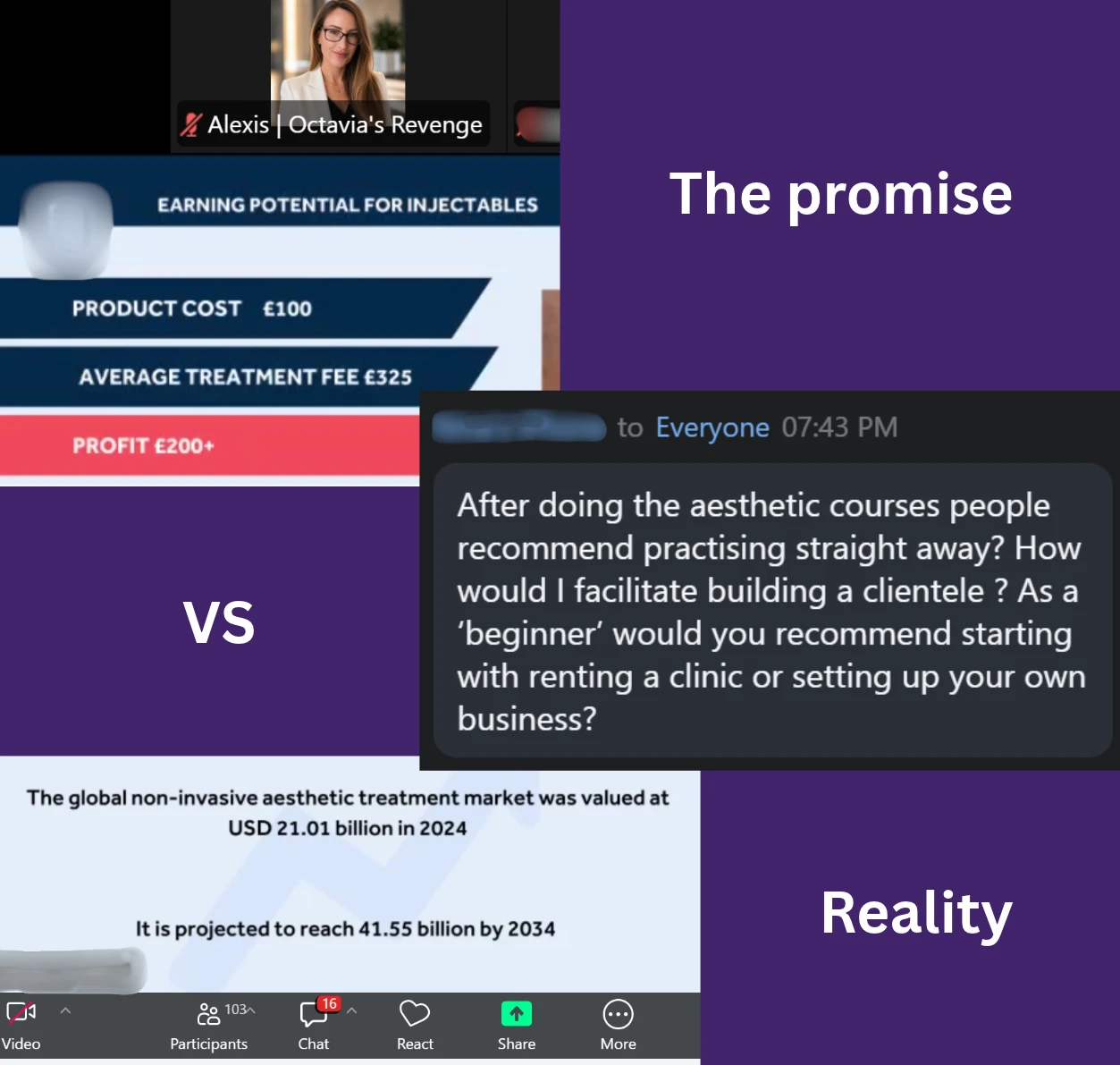
At a medical aesthetics webinar I attended recently, the participant counter showed 103 people on the call. The presentation was exploring the opportunities available to healthcare professionals considering a move into aesthetics, and the financial prospects certainly sounded attractive.
One slide illustrated the earning potential of injectable treatments using three figures: an average treatment fee of £325, a product cost of £100 and a resulting profit of more than £200. Another presented a forecast valuing the global non-invasive aesthetics market at US$21.01 billion in 2024, with projected growth to US$41.55 billion by 2034.
For somebody contemplating a new career, these are encouraging numbers. The industry appears to be growing, individual treatments seem to offer healthy returns, and the opportunity to develop an independent practice can begin to look commercially compelling.
But while the presentation was exploring the potential rewards, I was paying particular attention to the questions appearing in the chat. One attendee wanted to know whether people should begin practising immediately after completing their training, how a beginner could build a clientele and whether it was better to rent space in an existing clinic or establish their own business. Another asked about starting with a home-based clinic.
These were sensible, practical questions from people trying to understand what entering the industry would actually involve. And they highlighted a considerable distance between the financial possibilities being presented and the decisions someone would need to make before earning their first pound.
£325 minus £100 doesn't necessarily equal £225 profit
Let's start with the treatment economics.
If a practitioner charges £325 and spends £100 on the product, the £225 remaining is a contribution towards the other costs of delivering the service and operating the business. It isn't automatically net profit.
Depending on the practitioner's circumstances, there may be room rental, insurance, clinical consumables, payment processing fees, booking software, professional memberships, marketing expenditure and ongoing training costs to consider. The practitioner also needs to account for consultation time, record keeping, administration, follow-up appointments and the wider responsibilities of running a clinical service.
Some of these costs are directly associated with individual treatments. Others are fixed overheads that must be covered regardless of how many patients attend. Their impact will vary according to the business model, which is precisely why a treatment-level calculation cannot tell us whether an entire practice will be profitable.
Consider two practitioners offering the same treatment at the same price. One operates within an established clinic, benefits from an existing patient base and has relatively predictable overheads. The other is newly qualified, rents a room for occasional sessions and must invest time and money attracting patients from scratch.
Both might charge £325. Both might spend £100 on the product. Their actual financial returns could be markedly different.
The £225 figure isn't necessarily wrong as an illustration of the amount remaining after product cost. The problem arises when that amount is labelled or interpreted as profit without explaining what other costs remain to be deducted.
For someone deciding whether to invest thousands of pounds in training, that's a distinction worth understanding.
The multibillion-dollar market that doesn't tell you where to practise
The global market projection was similarly impressive. According to the figures displayed, the non-invasive aesthetics market was valued at US$21.01 billion in 2024 and forecast to reach US$41.55 billion by 2034.
A growing international market may indicate broad commercial momentum, although any forecast depends on its definitions, methodology and underlying assumptions. What it cannot establish is whether an individual practitioner has a viable opportunity in their chosen location.
The fact that consumers around the world are spending billions on aesthetic treatments tells us remarkably little about the demand for a particular service in Milton Keynes, Birmingham or Poole.
It doesn't reveal how many prospective patients live within a realistic catchment area, what treatments they're seeking, what they're prepared to pay or how many competing providers already serve them. Nor does it establish whether there's enough unmet demand to support another practitioner, particularly one with limited appointment availability.
These are the questions that matter when deciding where to practise, which services to offer and how much to invest.
A global market forecast can make an industry look attractive. It cannot tell an individual clinician whether their proposed business is commercially viable.
Meanwhile, the beginners were asking how to begin
What interested me most about the webinar wasn't the market forecast or even the treatment profitability calculation. It was the contrast between those figures and the practical concerns being raised by attendees.
Should someone start practising immediately after completing a course? Where should they treat patients? Is a home-based clinic appropriate? How does a beginner find their first paying clients?
These aren't peripheral questions. They sit at the intersection of clinical competence, professional responsibility and commercial planning.
Completing a training course doesn't automatically establish that someone is competent to practise independently. The answer depends on the treatment, the practitioner's existing qualifications and experience, the nature and extent of the training, appropriate supervision and the professional requirements involved.
Similarly, the choice between renting a room, establishing a home-based practice or opening dedicated premises isn't simply a matter of personal preference or finding the cheapest option. Each arrangement has implications for costs, patient experience, insurance, governance, suitability and potentially local planning or regulatory requirements.
Then there's the question of building a clientele. A practitioner might be technically capable of delivering a treatment and have access to suitable premises, yet still struggle to attract enough paying patients to make the business worthwhile.
That requires an understanding of local demand, patient behaviour, positioning, pricing and the channels through which prospective patients can realistically be reached.
I can't establish from the screenshots whether these questions were answered later in the session or addressed through other educational materials. But their appearance in the chat was revealing. While the presentation described the potential of the industry, at least some attendees were still trying to understand the basic mechanics of entering it.
And those mechanics are where an aspiring business owner's money, time and professional ambitions will ultimately be tested.
The training decision is also an investment decision
There's an important distinction between the clinical value of aesthetics training and the commercial opportunity someone hopes to pursue after completing it.
Appropriate education, supervised experience, ongoing development and patient safeguards are fundamental to responsible practice. They should never be compromised in pursuit of a faster or cheaper route into the market.
But choosing to undertake training with the intention of establishing a private business also involves an investment decision. The practitioner is committing money, time and potentially future resources to an opportunity whose commercial viability may not yet have been established.
That decision deserves the same scrutiny as any other significant business investment.
What is the intended outcome? Is the practitioner seeking supplementary income alongside an NHS career, a portfolio of public and private work, or eventually a substantial independent practice? How much time can they realistically devote to treating patients and running the business? What further experience and investment will be needed before they can operate safely and independently?
And, crucially, what evidence suggests there will be enough patients willing to pay for the services they intend to offer?
These questions won't necessarily produce immediate or reassuring answers. They may reveal that the practitioner needs more experience, that the proposed location is unsuitable or that the economics of the intended operating model don't support the original ambition.
They may also reveal a genuinely attractive opportunity.
Either way, it's better to understand the implications before committing significant sums based on an appealing treatment margin or an industry growth forecast.
Selling the opportunity versus explaining the opportunity
Training providers have every reason to communicate the potential of medical aesthetics. Practitioners considering a new career are entitled to understand the opportunities available, and there's nothing inherently objectionable about using financial illustrations to help explain them.
But there is a difference between demonstrating that money can be earned from a treatment and explaining what it takes to establish a commercially sustainable practice.
The first is relatively straightforward. The second requires consideration of the local market, the operating model, the cost structure, the practitioner's capacity, the time needed to develop a patient base and the risks involved.
A treatment fee can be displayed on a slide. A viable business model takes considerably more work to establish.
For aspiring practitioners, this distinction is particularly important because clinical expertise and commercial experience are not interchangeable. Someone may have spent many years working in healthcare without ever needing to evaluate market demand, calculate patient acquisition costs or develop a pricing strategy.
Presenting the earning potential of individual treatments without sufficient commercial context risks encouraging an overly optimistic interpretation of what establishing a practice might involve.
That doesn't mean the opportunity isn't real. It means the opportunity needs examining properly.
The diagnosis
At one point during the webinar, 103 people were present to hear about the possibilities offered by medical aesthetics. I don't know how many were considering purchasing training, how many were already practising or how many had previously run businesses.
But I do know that the questions appearing in the chat were as commercially significant as the numbers appearing on the slides.
A £325 treatment fee doesn't establish profitability. A £41 billion global market forecast doesn't establish local patient demand. And completing a training course doesn't automatically provide the clinical readiness, business infrastructure or patient base required to establish a successful practice.
Before making a substantial investment in aesthetics training, aspiring practitioners deserve to understand not just what they might earn from delivering a treatment, but what it will take to build a viable business around it.
Because the most important number isn't necessarily the profit displayed on a presentation slide.
It's the sustainable return the practitioner can realistically achieve, in their own circumstances, after accounting for the costs, commitments and risks of entering private practice.
Strategy before spend. Always.
This article draws on observations from an industry webinar. The financial figures are reproduced as displayed in the presentation and have not been independently verified. The article is not intended as a comprehensive assessment of the provider, its training programmes or any guidance delivered outside the material discussed.
About the author
Founder, Octavia's Revenge
Commercial, brand and marketing strategy for medical aesthetics businesses.
Keep reading
 Observations
Before you leave the NHS, do the maths.
Two conversations. Two very different ambitions. And one financial consideration that deserves considerably more attention.
Alexis Drake
 Observations
Frequent flyers: when another training course becomes the business plan
There's a pattern I'm beginning to recognise in medical aesthetics. Practitioners invest in clinical training, struggle to establish a paying patient base, and then decide that the next step towards growing their business is more training.
Alexis Drake
 Observations
Buying things for your aesthetics business isn't the same as building one
Eight minutes on Instagram, dozens of promises and a question every aspiring aesthetics practitioner should ask before reaching for their wallet.
Alexis Drake